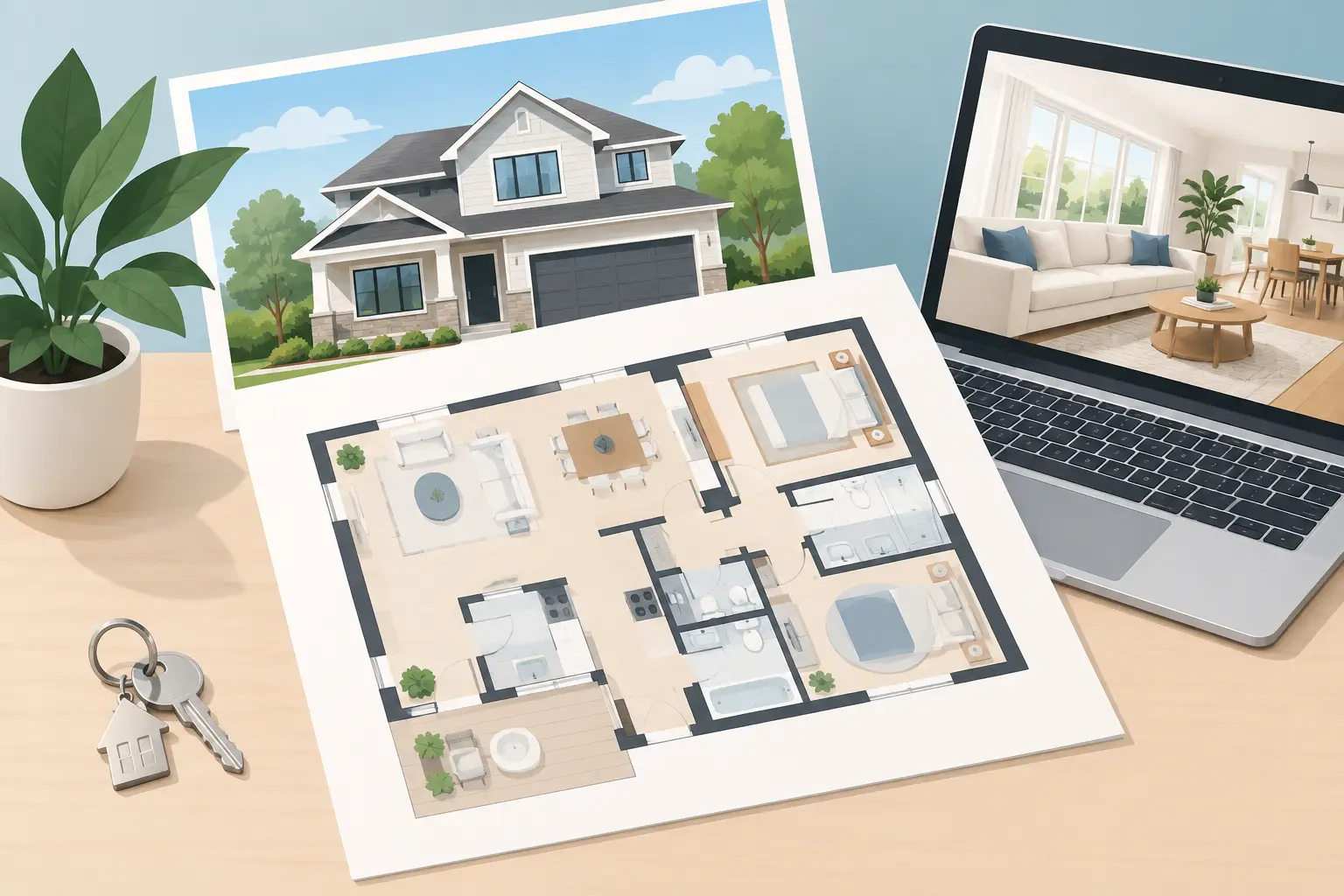
A buyer may love a bright kitchen photo and still hesitate because they cannot tell where the bedrooms sit, whether the dining area fits a table, or how the suite connects to the main home. Real estate floor plans answer those practical questions quickly. They give a listing structure, helping buyers understand the property before they book a showing.
For agents marketing homes across Surrey, Langley, Delta, White Rock, Vancouver, and the Lower Mainland, that clarity matters. Housing styles vary widely, from compact condo layouts and townhomes to split-level family homes, character properties, and new construction. Professional photography creates interest; a clear floor plan helps people make sense of what they are seeing.
Why Real Estate Floor Plans Matter to Buyers
Photos show finishes, light, condition, and atmosphere. Video adds movement and context. A floor plan does something neither format can do on its own: it presents the relationship between rooms at a glance.
Buyers use plans to answer highly specific questions. Is the primary bedroom separated from the children’s rooms? Does the lower level have a separate entrance? Is there space for a home office? How far is the laundry from the bedrooms? Can a sectional fit in the living room without blocking the patio door? These are not minor details when a buyer is narrowing a short list of properties.
A plan is particularly helpful when the layout has an unusual feature. Maybe the home has a legal suite, a converted garage, a flexible loft, or a garden-level entry. Maybe it is a large property where photos make rooms feel disconnected. In each case, the floor plan provides a simple visual reference that lets the buyer orient themselves.
This is also why floor plans can support stronger showing inquiries. People who understand a layout are better prepared to decide whether the home suits their needs. They may still have questions, but they arrive with a more informed reason to see the property.
What a Professional Floor Plan Should Communicate
A useful floor plan is not just a rough sketch with room names. It needs to be accurate, readable, and designed for fast interpretation on both a listing portal and a phone screen.
Room labels and dimensions are central. Buyers want to know the difference between a bedroom that fits a queen bed and one that comfortably handles a king bed, desk, and dresser. Dimensions also make it easier for downsizers, families, and investors to compare properties without relying only on wide-angle photos.
The plan should show doors, stairways, closets, hallways, major fixtures, and the overall flow of each level. These details explain how the home functions day to day. A kitchen may look spacious in photographs, for example, but a floor plan can show whether it opens to the dining area, includes a pantry, or has a practical route to the garage.
Square footage is valuable when it is presented carefully. Depending on the property and the reporting standard, an advertised size may include or exclude areas such as garages, unfinished basements, storage, or exterior spaces. A professional floor plan should make the scope clear rather than creating an impression of false precision. For agents, accurate representation is always more useful than a number that may cause confusion later.
Floor Plans Work Best With Other Listing Media
Floor plans are strongest when they are part of a coordinated media package, not an isolated add-on. A buyer often starts with the lead images, watches a property video, then studies the plan to confirm the details that matter to them.
Think of each format as doing a different job. HDR photography highlights the home’s condition and visual appeal. A cinematic video communicates pace, setting, and lifestyle. Drone content can establish lot position, nearby parks, water views, access routes, or neighborhood context. The floor plan brings those visual elements together into a functional map of the home.
This combination is especially effective for larger homes and properties with multiple levels. Without a plan, a buyer may not realize that the polished lower-floor recreation room is connected to two additional bedrooms, or that the suite entrance is on the side of the home. With one, the story of the property becomes easier to follow.
At KS MAGIK SHOT, we approach floor plans as part of the listing presentation. Capturing them alongside photography, video, and other visual assets helps create consistency in how the property is presented. The goal is not to overload buyers with media. It is to provide the right information in the format that makes it easiest to use.
When a Floor Plan Is Most Valuable
Nearly every residential listing benefits from a floor plan, but the value is especially clear in certain situations. Condos benefit because buyers compare layouts closely and need to assess storage, bedroom placement, and usable living space. Townhomes benefit because several levels can be hard to understand from photos alone.
For detached homes, floor plans are useful when the property has a basement, suite potential, addition, or a layout that differs from a standard rectangular footprint. They can also help market older homes where the charm is obvious but the room flow is less conventional. In new construction, a polished plan supports the sense of planning and finish that buyers expect from a builder or developer.
Investment properties are another case where plans carry real weight. Investors may want to evaluate separate entries, bedroom counts, common areas, and the practical division of space. Clear visuals help them assess the property before arranging a visit, often from outside the immediate market.
That said, the right approach depends on the listing. A simple one-bedroom condo may need a clean, concise plan with no unnecessary detail. A multi-level estate, duplex, or development project may call for more extensive plans that distinguish levels, exterior access, garages, patios, and secondary spaces. The presentation should match the complexity of the home.
Common Mistakes That Reduce Their Value
The most common problem is treating a floor plan as an afterthought. A low-resolution image, cramped labels, or missing room measurements can make buyers work harder than they should. If they need to zoom repeatedly or cannot read the plan on mobile, the asset is not doing its job.
Another issue is inconsistency. When a photo gallery calls a room an office but the plan calls it a bedroom, buyers may question the listing details. Room naming should be practical and aligned with the property’s current use and marketing strategy, while remaining accurate.
It is also wise to avoid making floor plans carry claims they cannot support. A plan can show a separate entrance, but it does not confirm zoning, legal suite status, permit history, or exact boundaries. Agents should pair visual clarity with accurate listing remarks and the appropriate property documentation.
Finally, presentation matters. A floor plan should feel like it belongs with the rest of the marketing materials. Clean typography, balanced spacing, and clear visual hierarchy signal care and professionalism. Buyers may not consciously analyze those design decisions, but they notice when a listing feels organized and easy to understand.
Preparing a Property for Floor Plan Capture
A floor plan appointment is straightforward, but a little preparation helps the process move efficiently. Ensure all rooms, closets, and access points are available. Move large obstructions away from doorways where possible, and let the media team know about locked suites, storage rooms, detached structures, or areas that should be included or excluded.
For occupied homes, it also helps to identify spaces with flexible uses. A den staged as an office, for example, may need a label that reflects how buyers will understand it. Clear communication before the appointment avoids assumptions and supports a plan that fits the listing strategy.
A well-made floor plan does not replace a showing, and it should not try to. It gives serious buyers a reason to take the next step with confidence. When the layout is easy to understand, the listing feels more transparent, more practical, and more ready for the questions buyers are already asking.
Leave a Reply